
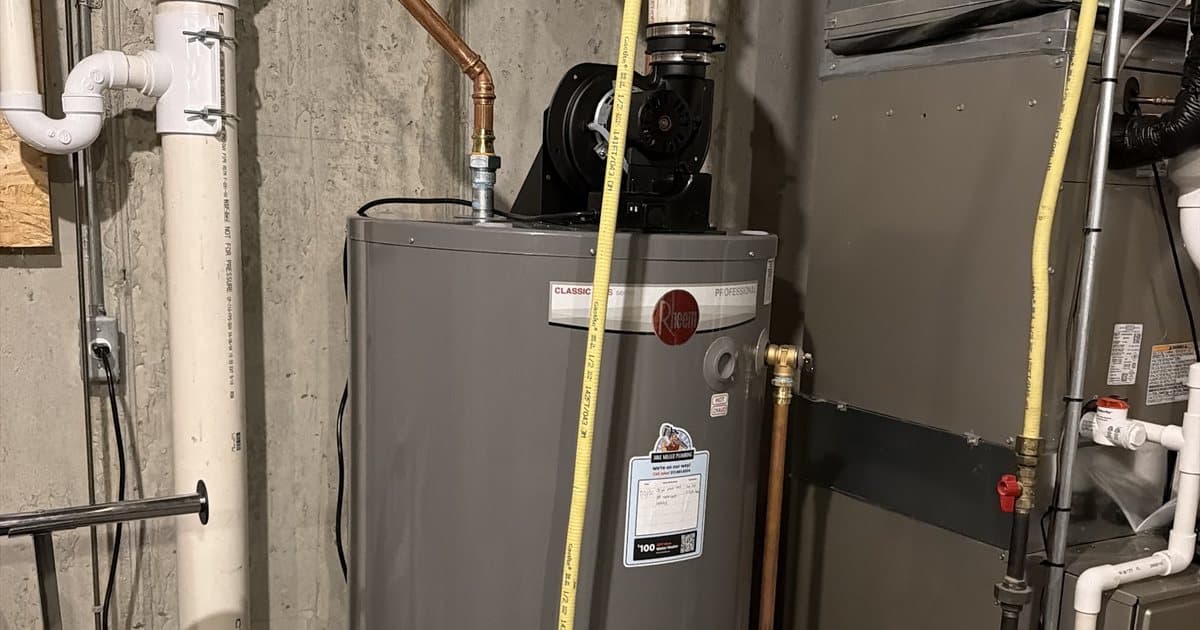
Last updated: November 10, 2026
Winter asks more of your water heater than any other season. The water coming into your home is colder, and a house full of holiday guests means more showers, more dishes, and more laundry. Here’s how to tell whether your water heater is ready, what you can safely check yourself, and when to call a licensed plumber.
Quick answer: Your water heater is ready for winter if it gives steady hot water, recovers quickly between showers, and shows no leaks, rust, or rumbling. Winter makes it work harder because the water coming in is colder, and holiday guests add showers, dishes, and laundry. If the tank is 8 or more years old or hasn’t had a tune-up in the past year, book a check before guests arrive.
Why Winter Is Harder on Your Water Heater
Your water heater’s job is to take the water coming into your home and warm it to the temperature you set. Plumbers call the difference the temperature rise. In winter, the water coming in is colder, so the rise is bigger, the heater works longer to reach the same temperature, and each tankful goes a little less far.
That’s why a water heater that kept up fine in July can run short in December. Nothing may be wrong with it. It’s simply doing more work, and any weakness it already has, like sediment in the tank or a worn part, tends to show up now.
How Much Hot Water Holiday Guests Use
A water heater’s first-hour rating is the number of gallons of hot water it can supply in one hour, starting with a full tank of hot water, according to the U.S. Department of Energy. It’s the most useful single number for judging whether your water heater can keep up on a busy morning.
The Department of Energy’s water heater sizing worksheet estimates how much hot water everyday tasks use. Here’s what a holiday morning can add up to:
| Activity | DOE estimate per use | Holiday morning |
|---|---|---|
| Shower | 20 gallons | 4 showers = 80 gallons |
| Automatic dishwasher | 7 gallons | 1 load = 7 gallons |
| Clothes washer (top-loading) | 25 gallons | 1 load = 25 gallons |
| Total | 112 gallons in one busy hour |
Compare that total with your water heater’s first-hour rating. If the morning asks for more than the heater can deliver, and colder winter water makes that harder, someone ends up with a cool shower. A few simple habits help:
- Space showers out when you can, so the tank has time to recover.
- Run the dishwasher and laundry after the morning rush, not during it.
- If your family runs short even without guests, your water heater may be too small for your household today. A plumber can check its rating against how you use hot water.
Signs Your Water Heater Isn’t Ready for Winter
Most water heaters give some warning before they give out. Watch for these:
- Hot water runs out sooner than it used to, or takes longer to come back.
- Water that’s only lukewarm, or temperatures that swing up and down.
- Popping or rumbling from the tank, which often means sediment has built up on the bottom.
- Rusty or discolored hot water.
- Dampness, drips, or rust around the base of the tank or its pipe connections.
- A tank that’s 8 or more years old.
One sign alone doesn’t always mean trouble. Two or three together are a good reason to have it looked at before guests arrive. For more on what each one means, see our guide to the 7 signs of a failing water heater.
Safe Checks You Can Do Before Guests Arrive
These checks take a few minutes and a flashlight. None of them involve opening panels, touching gas controls, or draining anything.
Find Your Water Heater’s Age
Look at the label on the tank. The manufacture date is often printed there or built into the serial number. If you can’t tell, we can read it for you during a visit.
Check the Water Temperature Setting
For most homes, 120°F is a comfortable, efficient temperature setting. According to the U.S. Department of Energy, turning a water heater down to 120°F can save $36 to $61 a year (2022). To see what you’re getting, run the kitchen hot water for a minute and hold a cooking thermometer in the stream.
If it’s much hotter or cooler than 120°F, don’t adjust it yourself. Changing the thermostat means opening electrical panels on an electric water heater or working the gas control on a gas one. Ask your plumber to set it during a visit.
Insulate Exposed Hot Water Pipes and the Tank
The U.S. Department of Energy lists insulating your water heater and pipes as one way to use less energy for hot water. Foam pipe insulation on exposed hot water pipes in an unheated garage, crawl space, or basement holds heat in and helps protect those pipes when temperatures drop below freezing. Leave the pipes closest to a gas water heater’s vent to your plumber, since insulation has to stay clear of it. For the rest of the house, our winter plumbing checklist covers frozen-pipe prevention.
A tank insulation blanket can help an older tank in a cold space, but it has to be fitted so it doesn’t block the burner, vent, controls, or relief valve, and some newer tanks don’t need one. Ask your plumber before adding one.
Watch for Leaks, Rust and Rumbling
Shine a flashlight around the base of the tank, the pipe connections on top, and the end of the discharge pipe that runs down the side from the relief valve. Dampness, drips, or rust are worth a call, and so is a new popping or rumbling sound when the heater runs.
While you’re there, keep the space around the water heater clear. Holiday decorations, boxes, paint, and cleaning products belong somewhere else, especially near a gas unit.
What to Leave to a Licensed Plumber
Plenty of water heater advice online tells homeowners to drain the tank or test the relief valve themselves. Those jobs involve scalding water and pressure, and other water heater work involves gas or electricity. Leave these to a licensed plumber:
- Draining and flushing sediment from the tank
- Testing the temperature and pressure relief valve
- Adjusting the thermostat or gas controls
- Checking the venting on a gas water heater or the wiring on an electric one
- Checking or replacing the anode rod
A licensed plumber can handle all of these in one visit and explain what they found in plain language.
Schedule a Professional Water Heater Tune-Up
A water heater tune-up is a once-a-year maintenance visit that checks a water heater’s safety parts and clears out what slows it down. At Jake Miller Plumbing, our water heater maintenance checklist includes:
- A sediment flush to help recovery and efficiency
- A temperature and pressure relief valve test and discharge check
- Thermostat verification and a temperature setting review
- A combustion and venting review on gas units, or electrical checks on electric units
- An expansion tank and visible piping inspection
- An anode rod condition check
Book it a few weeks before guests arrive, not the week they’re here. See what a professional water heater tune-up covers, or visit our water heater maintenance page to schedule one.
Want regular checkups handled for you? Save even more with Plumber for Life, our maintenance program for Central Indiana homeowners.
Tankless Water Heaters in Winter
A tankless water heater heats water as it flows, so it doesn’t run out the way a tank does. Winter still matters, though. To size a tankless heater, the U.S. Department of Energy suggests assuming incoming water at 50°F unless you know otherwise, which means a 70-degree rise to deliver 120°F water. It also notes that cooler incoming water can lower the temperature at the faucet farthest from the heater.
In practice, a full house running two showers and the dishwasher at once may notice cooler water. Tankless units also need periodic descaling to clear mineral buildup, and one in an unheated space may need protection from freezing. A plumber can check all three during a tune-up.
When Replacement Makes More Sense
If your tank is near or past a storage water heater’s typical life, or water is coming from the tank itself, a tune-up may not be money well spent. That’s the time to compare repair and replacement, and our guide to whether to repair or replace your water heater walks through the decision.
Jake Miller Plumbing offers free estimates on water heaters. Current coupons include $200 off tank-type water heaters, $450 off tankless water heaters, and $500 off hybrid water heaters, each with installation. See our current water heater coupons for details, and learn more about our water heater services. Financing available.
Get Ready Before the Guests Arrive
Jake Miller Plumbing is a family-owned residential plumber serving Central Indiana since 2001. We’re licensed and insured, with 4.9 stars from 500+ Google reviews. If you’d like your water heater checked before the holidays, call 317-861-8334 or schedule service online. Our office is open Monday–Friday 8:00–4:30.
Frequently Asked Questions
Why does my hot water run out faster in winter?
Because the water coming into your home is colder. Your water heater has to raise it more degrees to reach the temperature you set, so each tankful goes a little less far and takes longer to recover. Add holiday guests and the extra showers, dishes, and laundry, and you can run short even with a healthy water heater. If it’s happening more than it used to, sediment, a worn part, or a tank that’s too small for your household could be the cause, and a plumber can tell you which.
Should I insulate my water heater tank for winter?
It can help, mostly for an older tank in a cold garage or basement. The U.S. Department of Energy lists insulating the water heater and pipes as a way to save energy. Blankets need careful fitting around the burner, vent, controls, and relief valve, and some newer tanks don’t need one at all, so check with your plumber first. Wrapping exposed hot water pipes in foam pipe insulation is usually the easier place to start.
Can a water heater freeze in cold weather?
It can, if it sits somewhere unheated. The bigger risk is a water heater or its pipes in an unheated garage, crawl space, or outdoor closet, especially during a long cold snap or while the heat is turned down for travel. Insulating exposed pipes helps. If your water heater sits in an unheated space, ask your plumber how to protect it before the coldest weeks arrive, and see our winter plumbing checklist for the rest of the house.
Does a tankless water heater need special winter preparation?
Yes, a little. It won’t run out the way a tank does, but on a cold morning it may not keep up with as many showers and appliances at once, so stagger them when the house is full. Keep up with descaling to clear mineral buildup, and if the unit is in an unheated space, ask your plumber about protecting it from freezing before the coldest weeks.
Should I check the pressure relief valve before winter?
Yes, but have a licensed plumber do it. The temperature and pressure relief valve is a safety device that releases water if the temperature or pressure inside the tank gets too high. Testing it releases scalding water, and an older valve may not seal properly afterward. A plumber tests it as part of a water heater tune-up and can replace it if it isn’t working right. What you can safely do is look at the end of its discharge pipe for drips or dampness.


